


I find photos and reels of “how I mark up my Bible” inspiring. I like to see the artistic ways some people take notes in their Bibles. But no matter how appealing they are, those methods just don’t work for me. Color-coded highlights distract me because I’m constantly overanalyzing—Does this passage fit better with ‘green for gospel’ or ‘purple for prayer’? Or I forget the color code altogether. Adorable icons and decorative details are impossible because my drawing ability is non-existent. Instead of studying Scripture more deeply, I end up wallowing in inadequacy or fearing I’ll ruin my Bible because of my lack of art skills. And while I love stationery and have dabbled in washi tape, patterned paper, and liberal sticky-note use, I’ve finally accepted that I’m just not crafty. Raise your hand if you can relate.
You may have heard this popular sentiment: “A Bible that’s falling apart usually belongs to someone who isn’t.” But taking notes in your Bible doesn’t make you more spiritual. A Bible full of pretty notes doesn’t prove piety. Just as you don’t have to read the Bible, you don’t have to mark up your Bible. That said, taking notes in your Bible can be a helpful study tool that can increase your understanding of God’s Word.
When I stopped trying to adopt someone else’s Bible-marking method and embraced what worked for me—no matter how messy or unorganized it may seem to others—it became a source of spiritual growth and truly enhanced my Bible study. Taking notes in my Bible in ways that work for me made my study personal rather than academic. That’s as it should be, because God’s intention for our study of His Word is that it would be personal, relational, communion with Him.
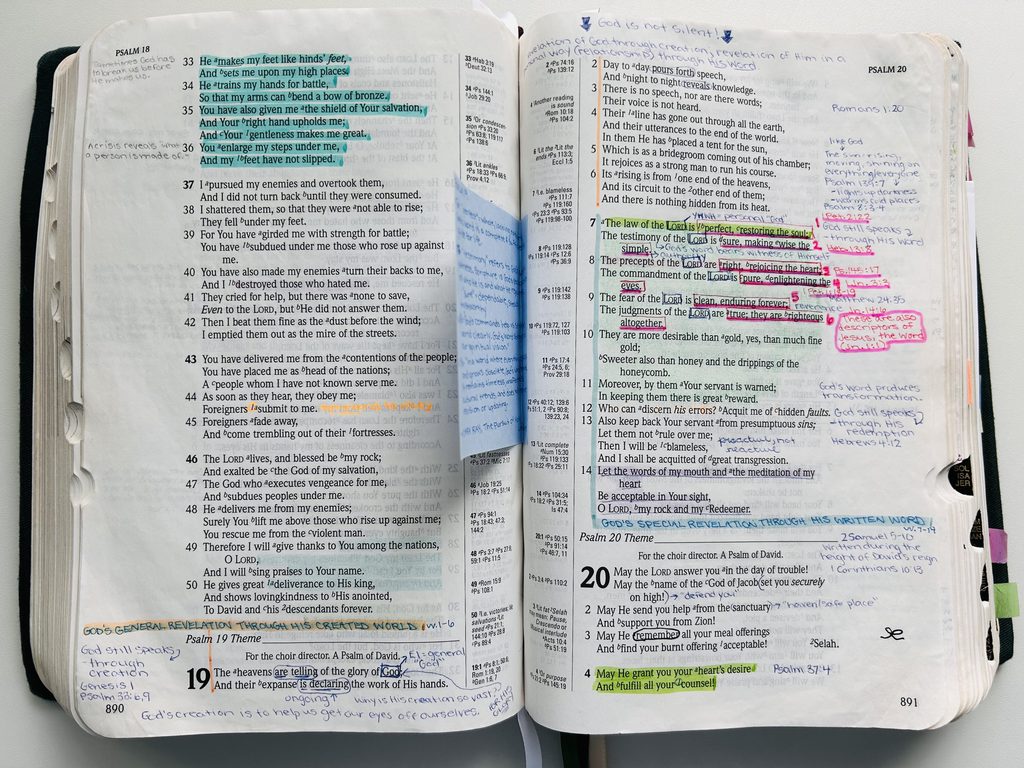
Is it okay to mark up my Bible?
Short answer: yes. Many people, out of a healthy respect for God and His Word, believe marking up your Bible is sinful. Sometimes this view comes from tradition, but sometimes it’s based on their interpretation of Revelation 22:18, which warns against adding to God’s Word. However, I believe taking notes in your Bible is actually commendable according to Scripture. Here’s why:
1. Taking notes in your Bible keeps you focused.
God commanded the kings of Israel to write out a copy of His law for themselves so they’d learn to fear Him, live according to His Word, and humbly stay the course (Deuteronomy 17:18–20). Now, they were literally copying Scripture, but note-taking can have a similar effect. Writing down what we’re learning helps us slow down and really pay attention to what the text actually says instead of rushing through a reading plan just to check the box. This deeper focus lays the groundwork for the kind of meditation on God’s Word that leads to transformation—hearts, minds, and lives that glorify Him.
2. Writing in your Bible helps you remember.
Our human minds are prone to forgetfulness. In Deuteronomy 6:6–9, God instructed His people to create visual reminders of His Word where they’d see them often. The margin notes in my Bible act as written reminders of what God has revealed to me through Scripture. Every time I return to a passage with my own margin notes, I’m reminded of His work in my life; it’s like a small “ebenezer” (1 Samual 7:12).
3. Notes in your Bible create a legacy.
There is biblical precedent for writing things down as a record for future generations. When I started annotating my Bible, I wasn’t thinking about leaving a legacy for my children. But one morning, while I was enjoying my Bible reading, one of our daughters gently interrupted me to ask if she could inherit my Bible when I die. My handwritten notes are a record of my walk with God, and she’d love to read them. Marking up my Bible is a way of telling the next generation the wondrous works of the Lord so that they “might know, even the children yet to be born, that they may arise and tell them to their children, that they should put their confidence in God and not forget the works of God…(Psalm 78:4–7 NASB).
Human Study Tools vs. God’s Inspired Word
Marking up your Bible is a matter of personal preference or personal conviction. If you just don’t want to, that’s okay. You can still benefit from note-taking or marking up the text by printing off a personal copy of a passage you’re studying and marking up the copy rather than your actual Bible.1 Or, perhaps even better, you can handwrite a copy of the Scripture and mark up the text as you study.
That said, if you’re still concerned about the concept of “adding to Scripture” (Rev. 22:18) by taking notes in your Bible, it helps to remember a few facts about how our modern Bibles came to be:
- Chapters and verses are human navigation tools. The original biblical manuscripts didn’t contain chapter and verse divisions. People added these centuries later simply to help us find specific passages as we study or teach the Bible. We don’t view these additions as altering God’s Word; they’re merely practical tools to help us navigate it.
- Explanations help us understand and apply Scripture. In Nehemiah 8:8, Ezra and the Levites read from the Law and “gave the sense, so that the people understood the reading.” In other words, they offered explanation or insight. Similarly, today’s study Bibles provide commentary and cross-references to help us understand the Scripture’s context and meaning. Just as we can clearly differentiate between God’s inspired Word and the notes and commentary added by humans, our personal handwritten margin notes are easily distinguishable from the inspired text. Making a note to help you understand or remember the truth of God’s Word is a way of engaging with—not revising—Scripture.
Taking notes in your Bible is a study tool. The purpose of annotating your Bible is to help you understand its message, remind yourself of that meaning next time you read, and keep a personal record of what the Lord teaches you through His Word.
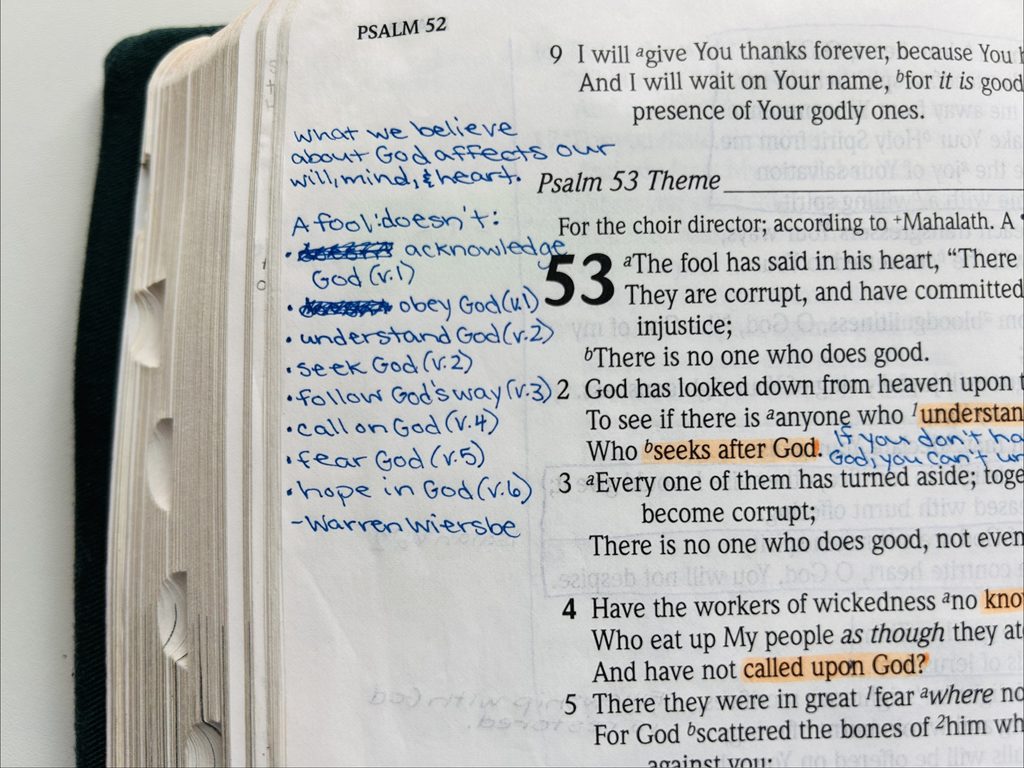
3 Simple Ways to Take Notes in Your Bible
Taking notes in your Bible doesn’t have to be complicated, formulaic, or artistic. A complicated color code only helps if it makes sense to you and actually aids your study rather than distracting you. You can use sticky notes or flags, highlighters, pencil (though it fades over time), pens (one color or many), etc. Or you can use other tools—a sketchpad and crayons, even! I like colors, so I use multiple pens and highlighters, but I have no system for choosing one over the other. I just pick whatever color I want in the moment, and I often choose a contrasting color when I add a new note to a verse I’ve previously highlighted or notated, so it’s easier to see. You might prefer to keep things very simple and tidy and uniform, and that’s fine, too. The key is to do what works for you; it’s personal! “You do you” applies here!
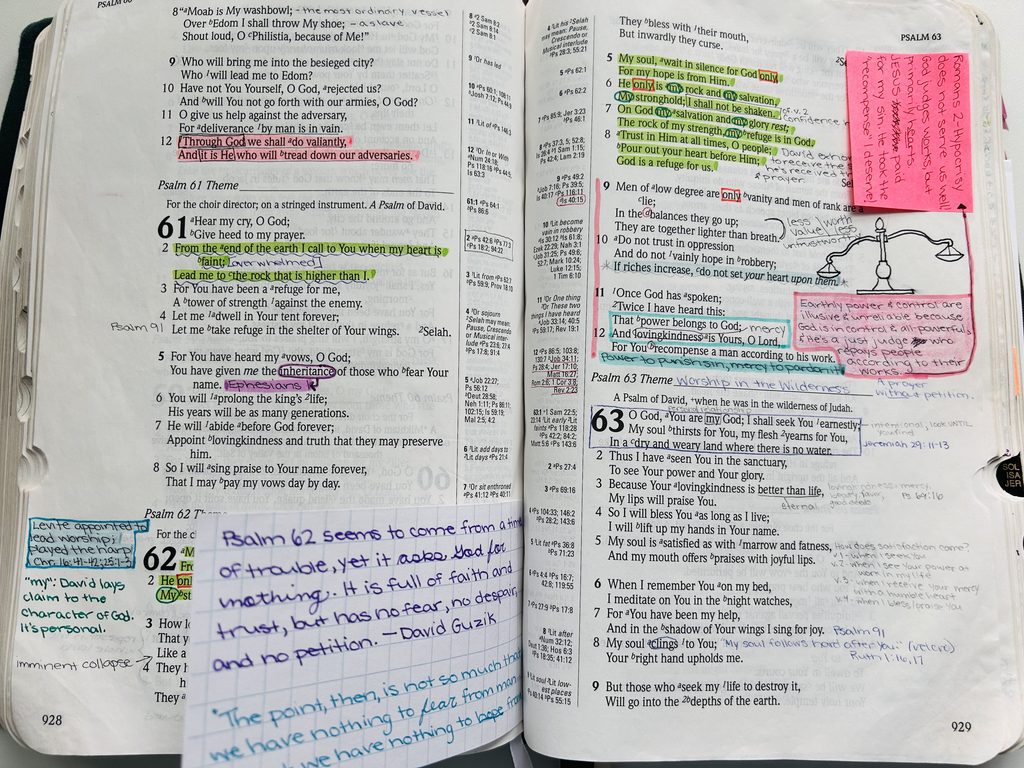
There are countless ways to take notes as you study the Bible, and endless things you could write down. To get you started, here are three simple Bible note-taking methods I’ve found helpful and easy to identify.
1. Repeated words, phrases, or ideas
Highlight, underline, or circle these so you can easily see where they are and where they’re concentrated. This helps us identify the passage’s key topics. Here’s an example:
“Beloved, let us love one another, for love is from God, and whoever loves has been born of God and knows God. Anyone who does not love does not know God, because God is love. In this the love of God was made manifest among us, that God sent his only Son into the world, so that we might live through him. In this is love, not that we have loved God but that he loved us and sent his Son to be the propitiation for our sins. Beloved, if God so loved us, we also ought to love one another. No one has ever seen God; if we love one another, God abides in us and his love is perfected in us” (1 John 4:7–12).
Underlining each instance of “love” shows John’s emphasis in this paragraph. (I bolded them instead of underlining them here because my website doesn’t let me underline.) Clearly, this passage is about love!
2. Lists or multiple points to prove or illustrate a message
The Bible is full of lists—lists of families and nations, rules and instructions, virtues and vices. For example, the genealogy of Jesus (Matt. 1), the table of nations (Gen. 10), the Ten Commandments (Ex. 20:1–17), the armor of God (Eph. 6:13–18), the works of the flesh (Gal. 5:19-21), and the fruit of the Spirit (Gal. 5:22–23). Numbering the list in your Bible or rewriting it in a notebook can help you slow down and really notice each point.
Similarly, it’s helpful to note a series of consecutive points that build an argument or prove a message. Here’s an example:
“How then will they call on him in whom they have not believed? And how are they to believe in him of whom they have never heard? And how are they to hear without someone preaching? And how are they to preach unless they are sent? As it is written, ‘How beautiful are the feet of those who preach the good news’” (Rom. 10:14–15)!
In this passage, Paul aims to convey the necessity of sending people to preach the gospel so more can be saved. He builds his argument using four consecutive points:
- People can’t call on Jesus without believing.
- People can’t believe without hearing the gospel.
- People can’t hear the gospel without someone preaching it.
- Someone can’t preach unless they are sent.
Listing each point in Paul’s argument—or numbering each one directly in the text—helps us better understand his flow of thought.
3. Questions and words or passages you want to study further
If a passage prompts a question in your mind that you don’t see an obvious answer to directly in the text, write it in the margin. You can return to it later in your study. Also note words or passages you want to study further. You might simply put a question mark beside them, or write a note in the margin.
Bonus Tip: If you want a couple more ideas, you could also note cross-references (other Scripture passages you’re reminded of) or insights you glean from a simple word study.
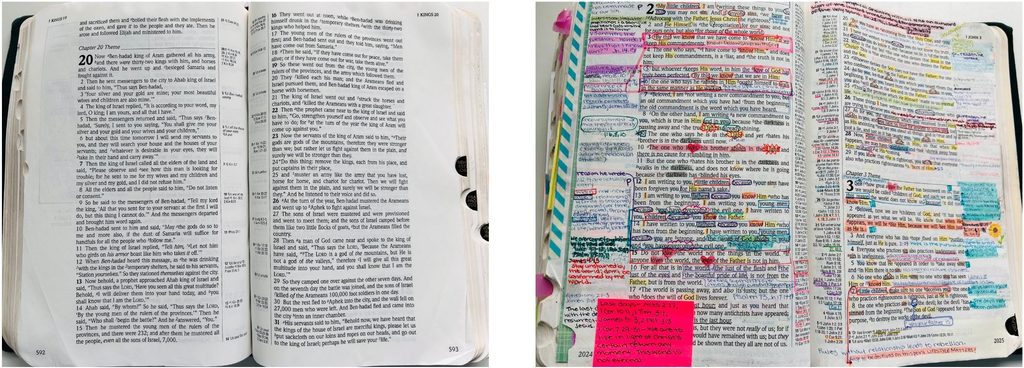
Choose Your Own Bible Note-Taking Method
As you learn more about studying the Bible, you’ll naturally discover more ways to notate a passage. Find what works for you.
Remember: taking notes in your Bible is meant to enrich your relationship with God, not burden you with rigid rules.
Don’t know where to start? Download one of my free Bible reading plans to start taking notes in your Bible about themes like wisdom, women, or who God is.
- Printing a copy of a Bible passage or book is easy from a website like Blue Letter Bible (blueletterbible.org) and others. Most Bible translations allow print copies for personal study. If you’re studying with a group, be sure to comply with their copyright guidelines. ↩︎