


Our human nature constantly asks, “What’s in it for me?”—even when we open our Bibles. We want to read verses that make us feel better—soothing our anxieties, comforting us in our unsettling circumstances, and affirming us in our insecurities. Sometimes, we treat the Bible like a Magic 8 Ball, seeking guidance for our lives, such as whom to marry or which job offer to accept.1 As though we’re on a personal shopping spree, we bounce around from one passage to another, looking for just the right one to answer our questions or fulfill whatever longing we feel most strongly in the moment. We expect every Scripture we read to be relevant to our own lives, so we tend to avoid passages—or entire books or even the whole Old Testament—when we can’t easily identify with them.
God’s Word is for our benefit. In fact, Paul told Timothy that all Scripture is God-breathed—inspired by Him—and useful (2 Timothy 3:16). That includes the Old Testament, those “boring” genealogies, and Ezekiel’s strange visions. Every verse, every passage, every chapter, every book is there for God’s purposes and our good. All of God’s Word is relevant to us and can fortify our faith.
So, can we approach all of God’s Word with eager anticipation of the transformative truth we desire? How can we discern the relevance of any Bible passage—even the ones that seem random or “dry”? Can we actually delight in the disturbing accounts of the evil judges or be inspired by Leviticus?
What the Bible is All About
Understanding the Bible’s storyline can help us find fulfillment every time we read God’s Word. While the Bible does teach us about ourselves and offers abundant encouragement, comfort, and guidance, it’s primarily about God. He is actually the main character—the hero—of His own story.
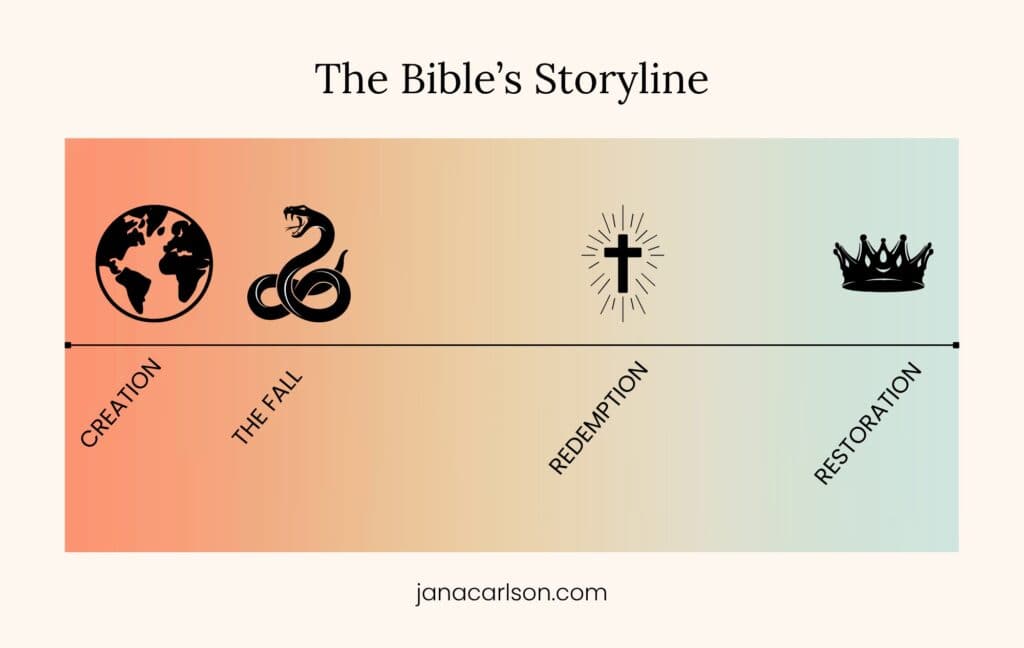
We can see God’s story throughout the Bible in four parts, like four acts in a play.
Creation
In the introduction (Genesis 1–2), God created the universe and formed humanity in His image to live in perfect relationship with Him. This introduces God as the main character. At the same time, it tells us about who we are, who we were created to be. We were made for a better place than our current reality; God created us for intimate communion with Him in an actual paradise.
Fall
The next part of God’s story introduces the problem (Genesis 3). Adam and Eve’s disobedience brought sin into the world, breaking their relationship with God. To this day, all of humanity—and, in fact, all of creation—continues to live under the consequences of sin, which causes death (Romans 8:22). This explains much of our current experience in this fallen world.
Yet, from the fall of Adam and Eve in Genesis 3 to the cross of Christ in the Gospels, God reveals Himself to humanity. He makes a covenant to redeem His people—to pay the ransom, buy them back, and deliver them from sin and death. Throughout the Old Testament, the historical accounts of prophets, priests, kings, sinners, and penitents all point to our need for a savior. And we know that Savior is Jesus Christ.2
Redemption
We see the solution to humanity’s sin begin to unfold in the Gospels with the conception of God’s Son, Jesus, in fulfillment of dozens of Old Testament prophecies. At the cross, Jesus Christ—the Messiah, humanity’s long-awaited Savior—gave His life as payment for our sins. He achieved for us what we could never have done for ourselves; He lived a perfect life, died on the cross to pay the penalty for our sin (the spotless Lamb, the final atoning sacrifice for sin), and rose again, offering salvation and new life to all who believe in Him for salvation. This is God’s redemption plan for humanity.
Restoration (or Consummation)
The final part in the Bible’s storyline is God’s full restoration of all creation. It’s the perfect happy “ending”, although it’s really just the beginning of the future. Some people refer to this part as “consummation,” which simply means completion, or the final righting of all wrongs. The battle against sin and death will finally cease, and even the effects of sin on creation will be no more. No more sickness, no more pain, no more tears (Revelation 21:4).
This is what we all long for, and it reminds us that this earth is not our home. We’re foreigners in this lost world; we belong to God’s kingdom. So we eagerly await His return (Hebrews 9:28), when God will restore order and usher in a new heaven and earth, where those who trust in Him will live eternally with Him in perfect fellowship—our future hope in God’s kingdom, fully realized.
Putting the Storyline to the Test (Even in Leviticus)
The whole Bible is about God, humanity, and the gospel (“good news”) of Jesus Christ—God’s redemption story. Reading the Bible with this overarching storyline in mind helps us see a passage’s relevance and glean the rich, life-changing message of Scripture God intended for us. (This is actually part of reading the Bible in context!)
A simple way to do this is to ask three questions:
- What does it reveal about God?
- What does it reveal about humanity?
- What does it reveal about Jesus Christ?3
You can learn more about this in another blog post: How to Read the Whole Bible as God’s Good News.
Let me show you an example.
In the book of Leviticus, verse after verse details God’s commands about how His people are to live. For example, Leviticus 19:9–10:
“When you reap the harvest of your land, you shall not reap your field right up to its edge, neither shall you gather the gleanings after your harvest. And you shall not strip your vineyard bare, neither shall you gather the fallen grapes of your vineyard. You shall leave them for the poor and for the sojourner; I am the Lord your God” (Leviticus 19:9–10 ESV).
Unless you own a field or a vineyard, it may seem that this passage is irrelevant to you. But let’s consider God’s redemptive story and what this passage might reveal about Him, humanity, and the gospel of Christ.
God’s Law provided direction for physical and spiritual health, established the national governance of Israel (His chosen people), and aimed to set them apart as distinct from all other nations. In other words, the Law was for the good of the people. And we can see that in this law that provided for those who could not provide for themselves.
The Law also revealed God’s character—definitely His holiness, but other aspects, as well. Consider the underlying principles of this particular law in Leviticus 19:9–10. It concerns caring for the vulnerable, practicing generosity, and stewarding our resources with others in mind. These principles reflect God’s heart!
Jesus Christ fulfilled the Law,4 so that today believers are no longer bound by the specific ritual and civil regulations detailed in Leviticus. But Jesus taught us to love our neighbor, to love sacrificially, and then He demonstrated that love through His own life, death, and resurrection.
The Beautiful View Through the Redemption Story Lens
Do you see how reflecting on Leviticus 19 through the lens of the Bible’s redemptive storyline transforms our understanding of the Scripture?
The next time you open your Bible, consider where the passage fits into God’s story. When we take off our self-centered glasses and look instead for God’s character, humanity’s need, and Christ’s rescue, every verse becomes relevant. Reminded of who He is and of His incredible love and amazing grace, we’re stirred to worship, and we’re motivated to walk in a way that reflects His love to those around us.
When we view the Bible through the lens of God’s redemptive story, we experience God’s Word as He intended—as the means by which we know Him more deeply and love Him more fully.
“All Scripture is breathed out by God and profitable for teaching, for reproof, for correction, and for training in righteousness…” (2 Timothy 3:16).
- Jen Wilkin, Women of the Word (Wheaton, Crossway, 2019), 41–46. ↩︎
- Faith Womack, No More Boring Bible Study (Grand Rapids: Zondervan, 2026), 49. ↩︎
- Thanks to Glenna Marshall for simplifying this idea in 4 Questions for Your Bible Reading in 2020. ↩︎
- Matthew 5:17. ↩︎