


Which Bible translation should I read? The vast array of Bible options nearly caused analysis paralysis when I was shopping for a new Bible 25 years ago. What if I bought a new Bible, only to realize later that it was too hard to understand—or worse, inaccurate? And why are there so many translations in the first place? Maybe you’ve wondered this, too.
These are common and important questions, and the answers can help us study the Bible with both confidence and delight.
Why are there so many different translations of the Bible?
We have translations of the Bible because the original Scriptures were written in Hebrew, Greek, and Aramaic, not English. The reason we have so many translations is that language is a living thing; it changes over time. For example, for centuries English speakers used “thou” and “thee” as pronouns, but by the 18th century, “you” had become the universal standard, largely replacing “thou”. So, as the KJV translators (1611) noted, a “ variety of translations is profitable” because, as English changes, our need for clarity grows.[1][2]
Some Bible translations were rendered directly from the original texts, while others use earlier translations as their primary source. We can sort Bible translations into three categories:
1. Word-for-Word
In a word-for-word translation, each word is carefully translated from the original language to the closest equivalent in English, sometimes resulting in awkward or hard-to-understand sentences.
These translations are also known as literal or formal equivalent translations. Examples include the New American Standard Bible (NASB) and the English Standard Version (ESV).
Let’s look at a sample.
1 John 3:24 NASB: “The one who keeps His commandments remains in Him, and He in him. We know by this that He remains in us, by the Spirit whom He has given us.”
Notice that the wording is a bit clunky? While accurate to the original text (which is crucial for Bible study), it’s not how we would say this in natural English today.
2. Thought-for-Thought
In a thought-for-thought translation, the intended meaning of the text—how the original audience would have understood it—is translated into English to convey that same meaning to today’s reader. Typically, this type of translation is easier to read than a literal version, but may not be as accurate to the original text in a word-for-word sense.
These translations are also known as dynamic or functional equivalent translations. Examples include the New International Version (NIV) and the New Living Translation (NLT).
Let’s look at how a thought-for-thought translation compares with a word-for-word translation.
1 John 3:24 NLT: “Those who obey God’s commandments live in fellowship with him, and he with them.”
Remember, the NASB version (above) translates the original text as “remain in Him.” Other literal translations use “abide in Him.” The NLT’s “live in fellowship with him” adds a layer of clarity. It shows that John is talking about more than mere existence; he’s describing an active, ongoing, relational connection with God, which is at the heart of the original word’s meaning in this context.
Paraphrase
This is essentially a retelling, like telling someone else’s story in your own words. It’s one person’s interpretation of the Bible, and is best treated as a supplement, like a commentary, not a primary source for Bible study.
A paraphrase is also known as a loose equivalent translation. An example is The Message (MSG).
Here’s an example comparing a paraphrase to a literal translation. Can you identify the author’s commentary in the paraphrase?
1 John 1:6–7 ESV (Literal): “If we say we have fellowship with him while we walk in darkness, we lie and do not practice the truth. But if we walk in the light, as he is in the light, we have fellowship with one another, and the blood of Jesus his Son cleanses us from all sin.”
1 John 1:6–7 MSG (Paraphrase): “If we claim that we experience a shared life with him and continue to stumble around in the dark, we’re obviously lying through our teeth—we’re not living what we claim. But if we walk in the light, God himself being the light, we also experience a shared life with one another, as the sacrificed blood of Jesus, God’s Son, purges all our sin.”
The Message paraphrase provides explanatory interpretations of the original text’s metaphors. For example, the interpretive phrase “we’re obviously lying through our teeth”—a modern idiom that assigns a specific, defiant tone not explicitly in the literal text. It’s an effective commentary, but it’s also one author’s interpretation of the original words.
Which Bible translation is most accurate?
Short answer: There isn’t just one. Because the original languages don’t map perfectly onto modern English, every translator must choose what type of “accuracy” to prioritize. Is word-for-word (or literal) translation more accurate, even if it feels clunky and harder to understand? Or is it more accurate to prioritize the intended meaning of the message in a way that the modern reader readily understands? Both are forms of faithfulness to the original text; they just define “accuracy” from different perspectives.
A helpful way to think about Bible translation is as a spectrum. While there are varying degrees of equivalence to the original text, the most literal translation is not necessarily better than a more dynamic one; each serves a valuable purpose.
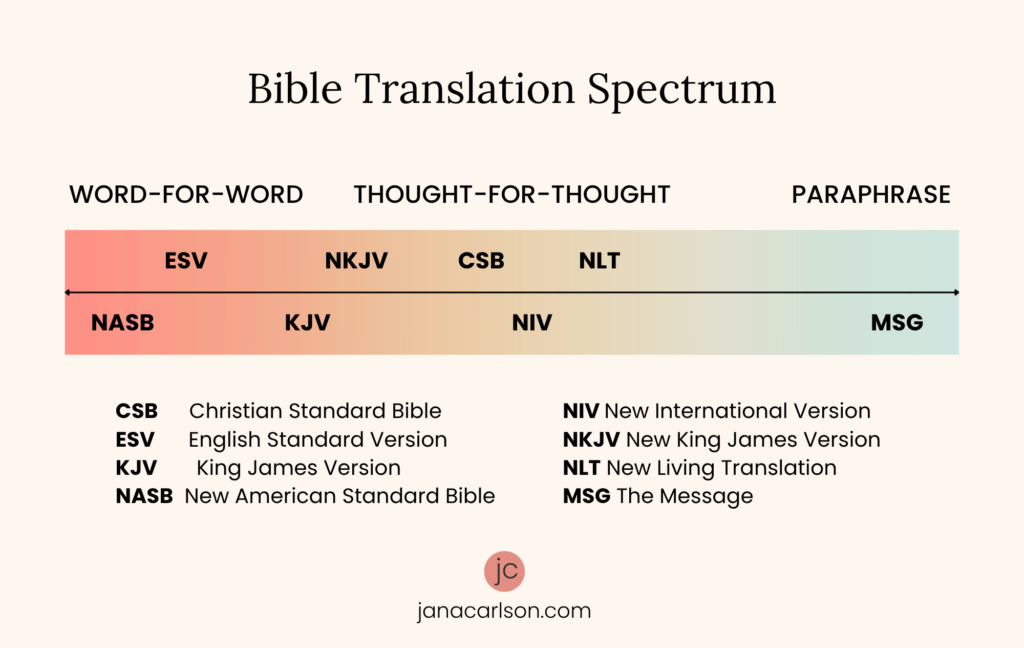
How to Choose a Bible Translation With Confidence
When choosing a Bible, read the preface of any Bible you’re considering. The preface contains information about the translation, including how the text was translated, why the new translation was created (its purpose and goals), and who was involved in the translation process. Here are a few crucial considerations:
- Look for a team. Reliable translations come from committees of scholars, not just one person. As Proverbs 11:14 wisely reminds us, “in an abundance of counselors there is safety.”
- Check the source. Was it translated from the original languages, or is it just an “update” of an older English translation? If the source was a previous translation, was it a word-for-word translation or a thought-for-thought translation?
- Examine uniqueness. Does it say something radically different from most other versions? If it’s “new and unique,” proceed with caution. Unique is usually a red flag.
I prefer using a variety of translations for Bible reading and study. For in-depth Bible study, I use a word-for-word translation, such as the NASB, as my primary source and supplement it with other translations as needed. For general reading or for an initial overview of a book of the Bible, I like a thought-for-thought translation like the NLT because it’s easier to understand and flows better. And for Scripture memorization, I gravitate toward the NKJV because its language is most familiar to me from my childhood and the preaching in my church.
Bible Translation Comparison Chart
Here’s a comparison chart to use for reference. It’s not comprehensive, but it shows you how some of the most common translations compare.
| Translation | Category | Reading Level | Great For… |
| KJV | Literal (Word-for-Word) | 12th Grade | Poetic beauty, traditional liturgy, and historical reference |
| NASB | Literal (Word-for-Word) | 11th Grade | In-depth study & precision |
| ESV | Literal (Word-for-Word) | 10th Grade | Formal study & liturgy |
| NKJV | Literal (Word-for-Word) | 9th Grade | Scripture memory and a bridge from the KJV to modern English |
| CSB | Optimal Blend | 7th Grade | Daily reading & balance |
| NIV | Dynamic (Thought-for-Thought) | 7th Grade | General use & clarity |
| NLT | Dynamic (Thought-for-Thought) | 6th Grade | Devotional reading & warmth |
| AMP | Unique Blend of Word-for-Word and Paraphrase | 11th Grade | Seeing shades of meaning (Use with discernment) |
| The Message | Paraphrase | 4th Grade | Creative perspective (Use as commentary) |
Bible Translations Help Us Study & Delight in God’s Word
For a simple Bible study exercise, read the passage you’re studying in various translations. This can provide a better understanding of unfamiliar or hard-to-understand words and phrases. Reading familiar passages in an unfamiliar, yet reliable translation can offer fresh insight. Visit Bible Hub, type the reference into the search bar, and you’ll see the verse listed in over 20 translations on a single page.
Don’t let the variety of Bible translations intimidate you. Instead, let it remind you of just how much God wants to be understood. He’s not hiding behind an ancient language; He’s inviting you to know Him more and to commune with Him through His message—preserved with care for millennia!
“The unfolding of your words gives light; it imparts understanding to the simple” (Psalm 119:130).
[1] https://founders.org/articles/excerpts-from-the-translators-preface-to-the-kjv-1611/

2 Responses
This really helped take away some of the pressure.
I’ve often felt unsure about choosing the “right” translation, so what you wrote about there not being just one perfect option was actually quite freeing.
I actually collect Bibles, mostly in Dutch, and I do use some English ones too — like a Messianic Bible, and one where you can scan things with your phone and listen to teaching alongside it. (Life Essentials Study Bible). I guess I’m always a bit like, “oh, maybe I should look into another one as well.”
I like what you said about using different translations instead of trying to find the one.
Do you have one you tend to return to the most, almost like a “home base”? I have my old Dutch one.
Praise God! I’m glad you found this post helpful.
My “go-to” Bible is my NASB Inductive Study Bible, only because I’ve been studying with it for over 20 years, and it’s full of my own notes. It’s familiar. There’s lots of space in the margins. And it’s durable—the binding is still holding strong. I guess you could say it’s “comfortable” to me—like sleeping in your own bed instead of somewhere else. 😆